To Bee or Not to Bee that is the question...
Please select your choice and hit submit.
Quiz results - Click here
When you think of bees it may make you scared, worried or even mad. Often times bees are associated with being stung, landing on your food or spoiling a nice picnic rather than an insect we depend on for survival. Bees actually have a very rich history and have been used and manipulated by humans for thousands of years. “Honeybees are considered to be protectors of humanity and guardians of the planet”.
Bees in History
Bees date back millions of years and they have a very interesting history. One bee species was found incased in amber and is believed to be from 100 million years ago. Their history goes hand and hand with pollination and working with humans.
 Honey produced by bees that visited Azalea plants are toxic to humans. In olden times, this honey was used as a weapon to poison enemies. Toxic honey was used to make a drink called mead; one story states that in Russia, during an invasion, the military left out toxic mead for the Turkish army to drink and it made the army parish and lead to Russia winning the battle. Since then, bees have been used as bombs, booby traps and commonly as pollinators for the agriculture industry. It is clear from the beginning that we rely on honeybees as an essential insect for our survival.
Working Bees Today
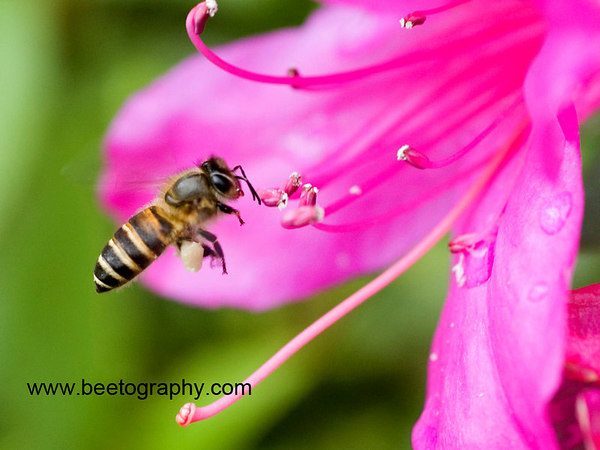
Are you affected by honeybee’s hard work? Honeybee pollination accounts for about one-third of the American diet. 84% of the approximate 300 commercial crops are pollinated by insects. The agriculture industry relies 90-100% on honeybee pollination for almonds, avocados, apples, blueberries, cherries, cranberries, kiwi fruit, macadamia nuts, asparagus, broccoli, cucumbers, carrots, cauliflower, celery, onions, pumpkins, squash, legume seeds, sunflowers and several other crops to a lesser degree.

A Bee Mystery
Bee populations have been plagued by disease, parasites, pathogens and other pests and can cause a decline in population. Bee-keepers see an average of 15% loss of honeybee colonies especially over the winter months each year . The most common issues honeybees face are vampire mites, tracheal mites, and the pathogen paenibacillus larvae.
Looking back at scientific literature there are documented cases of bee's "disappearing" noted in the 1880’s, 1920’s, and 1960’s. In 1903 there was a report of a “disappearing disease” that plagued Utah after a hard winter and cold spring. Another example of the disappearing bee mystery occurred in 1995 in Pennsylvania, where bee-keepers lost 53% of their colonies with no known reason . These incidents have been isolated to a small area and due to the lack of significant data or research regarding these “mystery” disappearances no one really knows what caused them or if they could come back.

Colony Collapse Disorder (CCD)
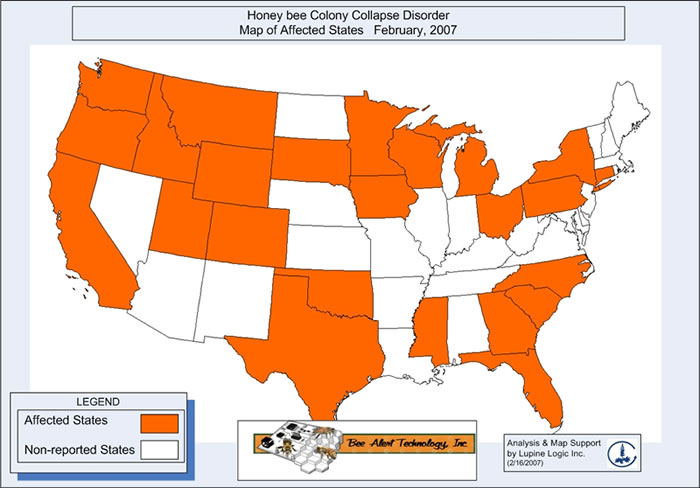
In 2006, commercial bee-keepers on the East Coast started reporting shocking declines in their honeybee colony populations and by the end of the year the same reports had spreading throughout the United States all the way to the West Coast. This issue spread far and quickly with no end in sight, it was nothing like had ever seen before. Due to the severity, extent of the affected areas, and unusual circumstances, this phenomenon has been named colony collapse disorder. By the summer of 2007 reports indicated that 35 states were affected and at least half of all bee-keepers surveyed had abnormal or severe losses. Some loss of honeybees is normal and is expected due many factors but the rates we are seeing are extremely uncommon. Follow the link below to view a 1st place infographic in the Broadcast Education Association’s 2012 Student Festival by Chris Kirkham to find out more about this disorder.

The danger of CCD is that honeybees are not returning to their hives (which is extremely uncommon), the colony losses are extremely quick and in large numbers, and we are still unsure of the exact cause of this disorder. “The main symptom of CCD is very low or no adult honeybees present in the hive but with a live queen and no dead honeybee bodies present. Often there is still honey in the hive, and immature honeybees (brood) are present. Varroa mites, a virus-transmitting parasite of honeybees, have been found in hives hit by CCD”. Another odd phenomenon associated with CCD is that the abandoned hives typically have honey in them and neighboring honeybees who would normally steal the honey don’t. The other odd occurrence that was discovered about CCD is that no dead bees are found near the abandoned hive and there is no evidence that the hive was attacked . Leading one to question what happened to the bees?
What Causes CCD?

The cause of CCD is still unknown making it an ongoing mystery and an unsettling fate for honeybees. Research has revealed many guesses but nothing conclusive. Some scientists believe that parasites, mites and/or disease in the bees and their young may cause this issue. Others believe CCD is caused by new types of pathogens, poor nutrition due to the lack of biodiversity, the lack of genetic diversity in the bees, stress from travel confinement or the environment, new types of agriculture related chemicals and pesticides, and many combinations of similar issues maybe contributing to the problem.
Recommendations
Until we discover a conclusive reason for CCD the United States Department of Agriculture recommends working to help improve bee’s health and habitat as well as provide supplementary nutrition as necessary. Similarly, many believe that the solution for CCD is taking better care of our environment and make long-term changes to our beekeeping and agricultural practices. The back to basics methods of bee-keeping has become more popular due to the increase of CCD by using the old-fashioned methods of bee-keeping and pest control practices.

Organic Bee-Keeping
One solution to help with CCD is organic bee-keeping. Organic bee-keeping technology is not a new phenomenon; it is simply a new spin on old-fashioned, traditional, bee-keeping technology to help find reasonable scientific solutions for traditional and modern bee-keeping challenges. Organic bee-keeping can help restore the health and habitat of the honeybee colonies by removing the chemicals and unnatural practices during bee-keeping. Organic bee-keeping is a holistic approach to bee-keeping that looks at the honeybee and the hive as a biological model using nature as the guide. Organic bee-keeping looks at bee-keeping as a tolerant, understanding practice that prohibits the use of chemicals to fight off pests.
Organic bee-keeping is focused on approaches to bee-keeping that avoids the use of nonrenewable sources, especially the ones that are made from petroleum. It is a type of bee-keeping that is not simply focused on a chemical free product as one may initially assume by the word organic. The true goal of organic bee-keeping is to mimic the honeybees in nature helping it become more sustainable and keep the bees healthy rather than just providing a chemical-free environment. This is very similar to the traditional practice of bee-keeping thought history.

Challenges of Organic Bee-keeping
One of the biggest challenges with organic bee-keeping is that no matter what the bee-keeper controls with their environment and the hive it is difficult to know if the honeybees pollinate any crop or flower that was sprayed with chemicals. Bees can travel up to 3 miles from the hive in any direction making it very difficult to monitor what flowers or crops they actually visited. Flowers and crops that are equally attractive honeybees as those that have not been sprayed so it is very easy for them to bring chemicals back to the hive unknowingly. The real priority is to not use chemicals in the bee-keeping practices and care for the honeybees in way nature intended, with as little exposure to man-made chemicals a possible. One may assume organic bee-keeping and organic honey goes hand and hand but most bee-keepers say truly organic honey, by consumers standards of organic, is next to impossible. New strains of honeybees raised on organic principals have proved to be resistant to CCD and other known honeybee challenges.
Please visit the next post "Help the Bees" to see what you can do!

References
Acharya, N. P., Saville, N., & Upadhyaya, S. (n.d.). The Farmers’ Handbook - “Near The House 1”, Chapter 12 - Beekeeping. In The Farmers’ Handbook. Retrieved from http://www.permaculturenews.org/courses.php
Barnosky, A. D., Matzke, N., Tomiya, S., Wogan, G. O. U., Swartz, B., Quental, T. B., Ferrer, E. A. (2011). Has the Earth’s sixth mass extinction already arrived? Nature, 471(7336), 51–57. doi:10.1038/nature09678
Conrad, R. (2013). Natural Beekeeping: Organic Approaches to Modern Apiculture. Chelsea Green Publishing.
Copeland, A. (2013, September 7). The role of plant partners. Presented at the AIP, Plants and People, Brookfield Zoo in Brookfield, IL.
Cox-Foster, D., & vanEngelsdorp, D. (2009). Saving the Honeybee. Scientific American, 300(4), 40–47. doi:10.1038/scientificamerican0409-40
Crane, E. (1983). The archaeology of beekeeping. Duckworth.
Crane, E. E. (2013). The world history of beekeeping and honey hunting. Routledge.
Garibay, S. V. (2011). General organic beekeeping data and market trends.
Fitzpatrick, D. (2014). Conscious Beekeeping Practices with Dan Fitzpatrick. Stonehouse Farm. Retrieved March 20, 2014, from http://www.stonehousefarm.com/interview-with-dan-fitzpatrick/
Freeman, J. (2013, February 19). Organic Bee Keeping: How To Prevent Colony Collapse Disorder. Earth Heal Videos. Retrieved April 9, 2014, from http://www.earth-heal.com/videos/viewvideo/1474/organic-bee-keeping-how-to-prevent-colony-collapse-disorder.html
Goulson, D. (2012, February 10). Decline of bees forces China’s apple farmers to pollinate by hand. China Dialogue. Retrieved March 20, 2014, from https://www.chinadialogue.net/article/show/single/en/5193
Johnson, R. (2007). Recent Honeybee Colony Declines (CRS Report for Congress) (p. 16). Washington, DC: Congressional Research Services.
Johnson, R. M., Ellis, M. D., Mullin, C. A., & Frazier, M. (2010). Pesticides and honeybee toxicity – USA. Apidologie, 41(3), 312–331. doi:10.1051/apido/2010018
Kluser, S., Neumann, P., Chauzat, M. P., Pettis, J. S., Peduzzi, P., Witt, R., & Theuri, M. (2010). Global honey bee colony disorders and other threats to insect pollinators.
Omlet Ltd. (2004). The history of the bee. Omlet. Retrieved March 20, 2014, from https://www.omlet.us/guide/bees/about+bees/
Pocol, C. B., & Popa, A. A. (2011). PERCEPTION STUDY REGARDING ORGANIC BEEKEEPING IN THE NORTH-WEST REGION OF ROMANIA. Agronomy Series of Scientific Research/Lucrari Stiintifice Seria Agronomie, 54(2)
Popa, A., Marghitas, L., Arion, F., & Pocol, C. (2012). Entrepreneurial behavior in the beekeeping sector as determinant of sustainable development. University of Agriculture Sciences and Veterinary Medicine, 131–124.
Suryanarayanan, S., & Kleinman, D. L. (2013). Be(e)coming experts: The controversy over insecticides in the honeybee colony collapse disorder. Social Studies of Science, 43(2), 215–240. doi:10.1177/0306312712466186
USDA. (2013, December 2). ARS : Honeybees and Colony Collapse Disorder. United States Department of Agriculture. Government. Retrieved March 20, 2014, from http://www.ars.usda.gov/news/docs.htm?docid=15572
vanEngelsdorp, D., Evans, J. D., Saegerman, C., Mullin, C., Haubruge, E., Nguyen, B. K., Pettis, J. S. (2009). Colony Collapse Disorder: A Descriptive Study. PLoS ONE, 4(8), e6481. doi:10.1371/journal.pone.0006481
Winfree, R., Williams, N. M., Dushoff, J., & Kremen, C. (2007). Native bees provide insurance against ongoing honeybee losses. Ecology Letters, 10(11), 1105–1113. doi:10.1111/j.1461-0248.2007.01110.x